Observation · Reflection · Visibility · Insight · Accountability
One method. Every review. It gives us discipline, gives you predictability, and gives whoever reads our finding a way to test it.
Five steps. One human. A written finding.
Observation. Reflection. Verification. Insight. Accountability. Each step is done by a named reviewer, on the record, in plain English.
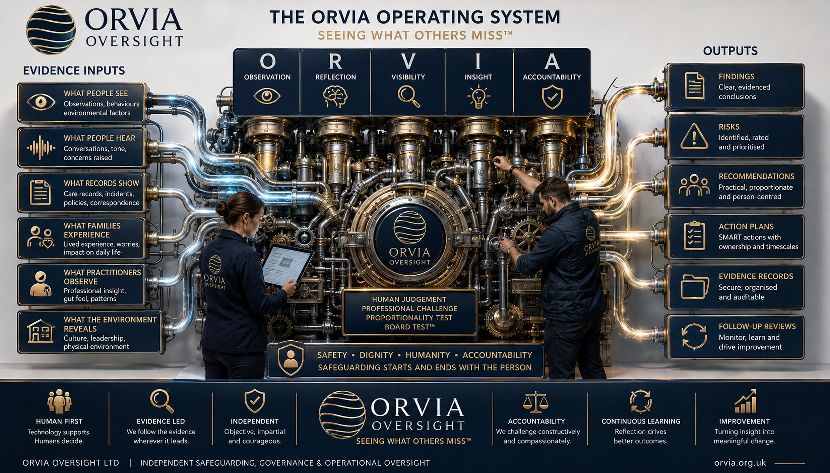
The ORVIA Method — Observation, Reflection, Visibility, Insight, Accountability.
-
O
Observation
What is happening — in the environment, in the paperwork, in the conversations, in the pattern of incidents. We look at what is there, and what is missing.
-
R
Reflection
What does the evidence mean? What does it stop short of saying? Where do the accounts diverge? Where does the record contradict lived experience?
-
V
Visibility
What is not currently being seen — by leadership, by the family, by the regulator, by the record? Visibility is where the honest read lives.
-
I
Insight
What needs to change, and why. Not opinion — reasoned finding. Every insight in an ORVIA report traces to the evidence that produced it.
-
A
Accountability
Who owns the next action, and by when. Reports without an owner and a date are documents; ORVIA reports assign both.

Review stages
- Enquiry received & triaged.
- Gate One suitability decision (within 3 working days).
- Scope, fee and delivery plan issued in writing.
- Fieldwork — observation, evidence, confidential conversations.
- Reflection and drafting.
- Written independent review issued to the named responsible person.
- Optional follow-up read at 90 or 180 days.
Evidence handling
Public-site enquiries do not include evidence uploads. If a case proceeds beyond Gate One, we open a private encrypted workspace with per-case access controls. Evidence is retained for the duration of the review plus statutory retention requirements, and destroyed on the schedule set out in the engagement letter.
Human approval and constructive challenge
Every ORVIA finding has a named human reviewer who is accountable for it. Draft findings are constructively challenged internally before they are issued. Where findings will be contested (which is often), we make sure the reasoning traces cleanly to evidence — because that’s what will hold in a hearing, a panel or a boardroom.
Reporting and action ownership
Every ORVIA report ends with named actions, named owners and named dates. A report without owners is not a review — it’s a document.